The Army’s biggest software story this fall isn’t a new weapon. It’s an app store, more or less. On Oct. 7 the Army announced its first round of Next Generation Command and Control (NGC2) application awards, and it said plainly that more would follow through an open solicitation. With the AUSA annual meeting running Oct. 12–14 in Washington, NGC2 is the program a lot of software people are talking about this week.
We’re a small software firm in San Antonio, and we’ve been asked the same question several times already: can a shop like ours actually get into this? Here’s what was awarded, how the buying works, and where we think smaller teams realistically fit.
What the Army actually awarded
According to the Army, commercial applications were “evaluated and awarded” to nine vendors: General Dynamics Mission Systems, Air Space Intelligence Federal, Immersive Wisdom, LMI, Mente Systems, Stilman Advanced Strategies, Onebrief, Rune Technologies and AIR. The initial collective one-year value is about $93.6 million.
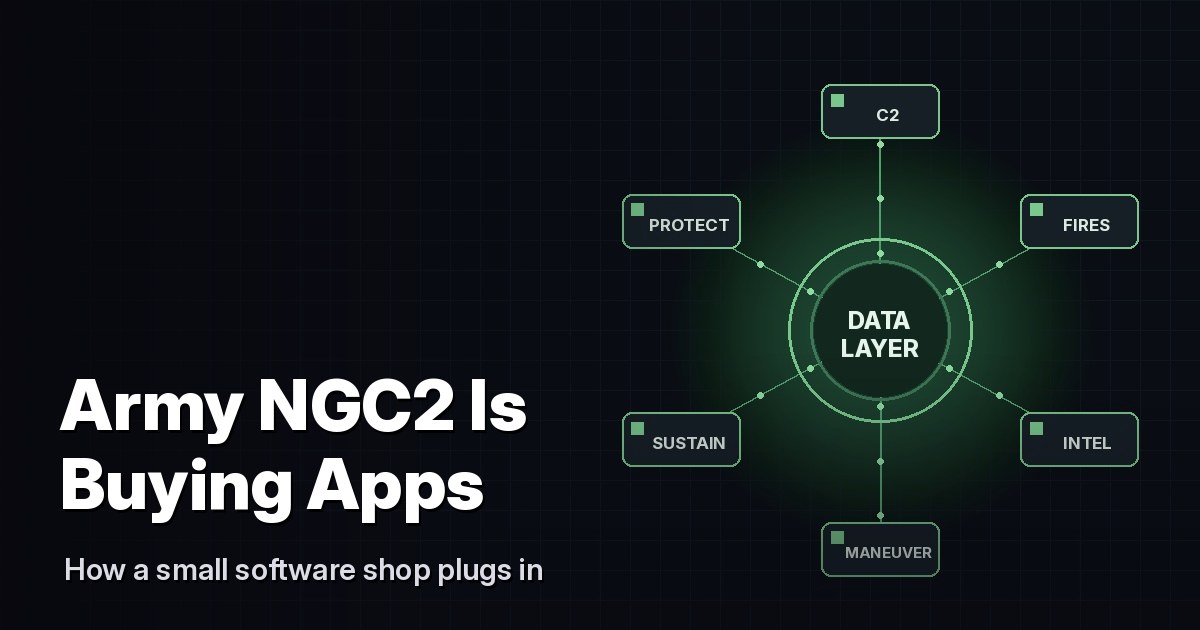
Those apps sit on top of work already underway. The same announcement says the awards “add to the software capabilities provided by Anduril, Palantir, Raft and Striveworks for the NGC2 data layer and core artificial intelligence capabilities.” Together, the Army says, the ecosystem covers six warfighting functions: C2, Fires, Intelligence, Movement/Maneuver, Sustainment and Protection.
The software has been through real use. It was prototyped with the 4th and 25th Infantry Divisions, used across a division formation at Project Convergence Capstone 6 in July, and I Corps is next in line to receive it.
Separately, on Oct. 12, AIR (the company styles itself Air) announced a $200 million, five-year contract supporting NGC2, focused on sustainment and readiness. That’s a company press release, so treat it as the vendor’s description rather than an Army statement.
The line that matters for everyone else
The most important sentence in the Army’s announcement isn’t about the nine winners. It’s this:
The Army will continue to evaluate and award commercial technologies via the NGC2 Commercial Solutions Opening (CSO), aligned with NGC2’s approach to deliver affordable capability at the pace of relevance.
Brig. Gen. Shane Taylor added that the Army is “providing a blueprint and reference point for how industry can integrate in the future with interoperability and speed.” In other words, the door didn’t close on Oct. 7. The Army built a common data layer and is now buying apps that plug into it, on a rolling basis.
Commercial Solutions Opening vs OTA
People mix these up constantly, so here’s the short version.
A Commercial Solutions Opening is authorized by 10 U.S.C. 3458 and implemented in DFARS Subpart 212.70. The government publishes a general solicitation describing a problem area, companies send in proposals (often a short white paper or pitch first), and the government reviews them by peer, technical or operational review instead of a traditional side-by-side source selection. Key points:
- Awards must be fixed-price (including fixed-price incentive).
- What you’re selling is treated as commercial, which brings lighter FAR Part 12 terms.
- The process counts as competitive, and the statute allows follow-on production, including sole-source follow-ons subject to approvals.
An Other Transaction (OT), most often a prototype OT under 10 U.S.C. 4022, isn’t a FAR contract at all. It’s a flexible agreement for prototyping, and if the prototype was competitively awarded and successfully completed, it can lead to a follow-on production award without recompeting.
The two aren’t rivals. As MITRE’s Acquiring Commercial Solutions guide notes, a CSO can itself be used to award FAR contracts or prototype OTs. The practical difference for a vendor: a CSO wants a commercial product with a price, and an OT wants a prototype project. NGC2’s app round is shopping for the first.
Where a small software shop fits
Being honest: a five- or ten-person firm is unlikely to win a standalone NGC2 app award next quarter. Those went to companies that already had fielded products and had been through the division-level prototyping. But an ecosystem like this creates a lot of work around the apps, and that’s where smaller teams fit.
Teaming with an awarded vendor. Nine app vendors and four data-layer companies now have to deliver to I Corps on a one-year clock. Some will need extra hands for integration, testing, deployment and training support. That’s classic subcontract work, and we covered the mechanics in how to become a software subcontractor for defense primes.
Integration against the data layer. The whole point of NGC2 is a common data layer that many apps share. Every app, and every future CSO entrant, needs connectors, data mapping, message translation and test harnesses against that layer. If your team is good at plumbing (APIs, event streams, schemas, edge sync over bad networks), that’s a direct fit.
Data standards and interoperability. “Modular, open architecture” only works if the data contracts are disciplined. Shops that can write and enforce schemas, versioning and conformance tests are useful to everyone in the ecosystem.
Authorization evidence. No app runs on an Army network without an Authority to Operate. Software Fast Track (SWFT) and continuous ATO are pushing toward automated, machine-readable security evidence: SBOMs, pipeline scans, signed builds. We wrote about that in faster ATO for small vendors. A vendor that shows up with that evidence already flowing is easier to buy and easier to team with.
A narrow app of your own. If you do have a real product in one of the six functions, especially a sustainment, logistics or planning niche, the CSO is the route to watch. Expect to show it working, priced fixed, and integrated with the data layer.
How to get ready this quarter
If NGC2 is on your list, here’s what we’d do now:
- Get registered. Active SAM.gov registration and a UEI. Nobody can pay you without them.
- Read the NGC2 CSO and its areas of interest when you find the current posting, and note how submissions are made (white paper, demo, pitch).
- Map yourself to one function and one layer. “We do C2 software” is too vague. “We build sustainment data connectors to the common data layer” is a pitch.
- Pick two or three of the awarded vendors whose products sit near your skills, and reach out about integration or delivery support.
- Build your security evidence now, not after someone asks. SBOMs, CI scanning and a written system boundary go a long way.
- Price it as a product. CSO awards are fixed-price, so know what a deployment, a license or an integration costs before the conversation starts.
The San Antonio angle
San Antonio is a military city with a fast-growing defense tech scene, and a lot of the I-35 corridor’s defense software work looks exactly like this: integration, data and secure delivery around larger platforms. We wrote about that cluster in the I-35 defense corridor. NGC2 is a good example of why. The headline awards go to a few companies, but the work of making an ecosystem actually function spreads much wider.
Where we can help
We work with defense and dual-use teams on integration, data platforms and secure delivery pipelines, and as a fractional CTO for startups figuring out how to position a product for programs like NGC2. If you’re sizing up the NGC2 Commercial Solutions Opening or looking for an integration partner, book a call and we’ll tell you honestly whether it’s a fit.